


2. THEORETICAL FOUNDATIONS
2.2. Material balance
This transfer mechanism occurs when the boundaries of a system are susceptible to a single component of the mixture. For example, in operations of absorption, humidification liquid-liquid extraction, when the properties of the interface can be seen that the circulation regime is laminar. In these cases we assume that the interface is waterproof.
- COUNTERCURRENT FLOW .
The gas stream at any point in the column, either filling or plates, consists of a flow (G), which are the total moles divided by the unit of time, as it is a transfer unit that occurs in continuous. Consists of a solute A, as a mole fraction (y) and partial pressure (P) or molar ratio (Y). In addition there is a gas that are not disclosed, since it is essentially insoluble (Gs), which is divided in moles per unit time.
In addition there is also a liquid stream (L) that moles are divided by time unit, where contains a mole fraction (x), a soluble gas or a molar ratio (X). Moreover, the Ls are moles divided by the time unit of a solvent that is not volatile.
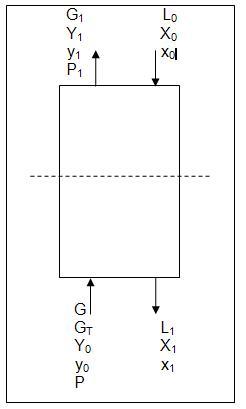
Figure 2.1: Diagram of a counter current absorption column.
The molar ratios are calculated:
- For the gas phase:

- For the liquid phase:

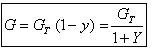
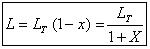
Therefore, we have the following relations:
- For the gas phase:
- For the liquid phase:
Below are mass balances for both a column of plates as a filler at the bottom:
- For a column of plates :

- For a column of filling:
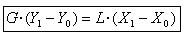
Where :
Np: number of plates.
These equations are belong in the line of operation, this line is a straight line only when relate units of molar ratio (X and Y), so if relate units of molar fraction we obtained a curve instead of a straight line. So the equation becomes:
- For a column of filling:
* For the gas phase:
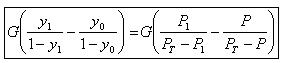
* For the liquid phase:
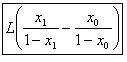
Where:
PT: pressure is considered constant at any point of the column.
- FLOW IN PARALLEL.

Figure 2.2: Diagram of a column absorption in parallel.
In this case, the operation line has positive pending , unlike in counter current columns, this pending is negative (-L/G).
Such columns can be vertically or horizontally, and are not limited. Because they are infinitely higher, the liquid and gas are in equilibrium.
This parallel flow is usually used when a column or tower is extremely high, and they are built with two sections. With the second section operating in parallel current flow, can also be used if the gas that dissolved in the liquid is a pure substance. Also used the system in parallel when give irreversible chemical reactions.